You're logged in with MyAlex  |  Logout

City of Alexandria, VA

Search results cleared

Include archived pages
Most of the content here is written in English. Translate your search to find more content? Translating "" to English... Searching for English phrase ""
  • Live
  • Play
  • Services
  • Business
  • Government
  • Projects & Plans
  • Calendar
  • I want to…

Collections from the Murray-Dick-Fawcett House

These items of clothing, representing several generations of residents of the Murray-Dick-Fawcett house, were donated to The Lyceum by a former owner. These are among the objects that appeared in the 2002-2003 Lyceum exhibit "Generations: Costume in Alexandria."
Page updated on November 22, 2021 at 11:52 AM

Historic Sites

  • Historic Alexandria (Home)
  • About Historic Alexandria
  • City Museums
    • Alexandria Archaeology Museum
    • Alexandria Black History Museum
    • Alexandria History Museum at The Lyceum
    • Fort Ward Museum & Historic Site
    • Freedom House Museum
    • Friendship Firehouse Museum
    • Gadsby's Tavern Museum
    • Stabler-Leadbeater Apothecary Museum
  • City Historic Sites
    • Alexandria African American Heritage Park
    • Alexandria Union Station
    • Contrabands and Freedmen Cemetery Memorial
    • Lloyd House
    • Murray-Dick-Fawcett House
    • The Fort: A Post-Civil War African American Community
  • African American History Division
  • Alexandria Oral History Center
  • Archives and Records Center
  • Commissions Supporting Historic Alexandria
  • More Historic Sites
    • African American Heritage Trail
    • Del Ray and the Town of Potomac
    • Historic Cemeteries
    • Union Hospitals during the Civil War
    • Wayfinding: Historic Signs
  • News Releases
  • Stay Connected
  • Support Historic Alexandria
    • Make a Gift
    • Become a Member
    • Join a Commission
    • Volunteer

Share

Bluesky Share on Facebook Share on X Share via Email
Translate icon
Translate icon
XWARNING: You have chosen to translate this page using an automated translation system. This translation has not been reviewed by the City of Alexandria and may contain errors.

Clothing Collection

John Douglass Brown purchased 517 Prince Street in 1816. Following his death in 1830, the property passed through several generations eventually going to Richard Lewis Cheeseman, Brown’s great, great grandchild. Over the years some furnishings and various personal artifacts remained in the house and were shared by those who lived there. When Mr. Cheeseman sold the property in 2000 he generously donated many items, particularly several articles of clothing, to The Lyceum. Here, we describe a sampling of the clothing found in 517 Prince Street. In some instances, they have been identified to having belonged to specific people.
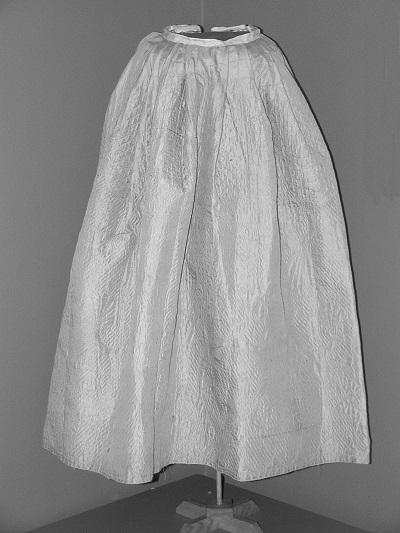
Petticoat, 18th century
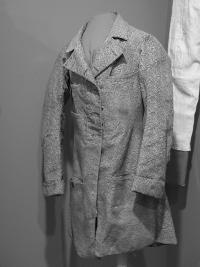
Hunting jacket, printed cotton velvet, 1850s
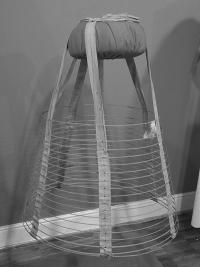
Crinoline, wire underskirt, 1870s
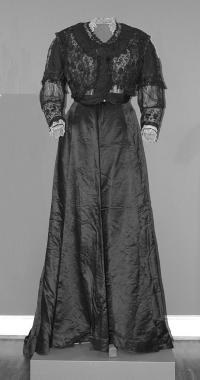
Bodice and skirt, ca., 1905
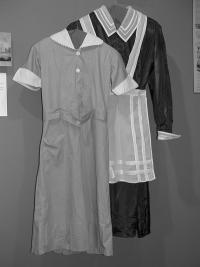
Maids uniforms, 1850s. Grey cotton for daily use and black dress uniform
of
Grid View Close Modal
Petticoat, 18th century
Petticoats like this one were common in the 18th century. They were usually produced by the cottage industries of Europe for export to foreign markets. Notable for its fine workmanship, it’s made of silk and has extremely thin, almost non-existent wool batting that would be suitable Virginia’s temperate climate.
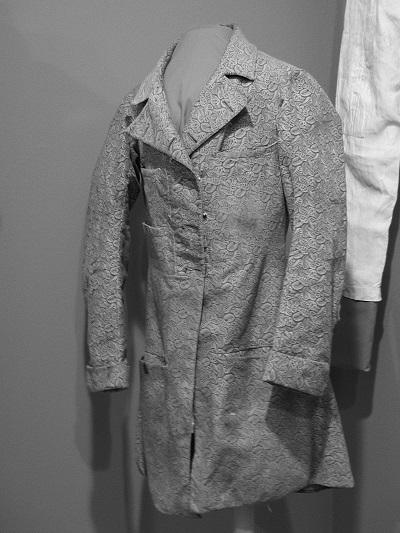
Hunting jacket, printed cotton velvet, 1850s
Hunting Coat, 1850s
Made in printed cotton velvet, this coat designed for hunting was cut in the narrow-waisted shape characteristic of men’s coats of the period. A beaver cap and two bags made of heavy-weight linen and leather, for carrying supplies or even small prey such as birds, were saved along with the hunting coat. According to family tradition, this sporting wear belonged to James Wallace Hooff, who would have been about 30 years old at the time. He was married to John Douglass Brown’s daughter Jannett Hooff Brown.
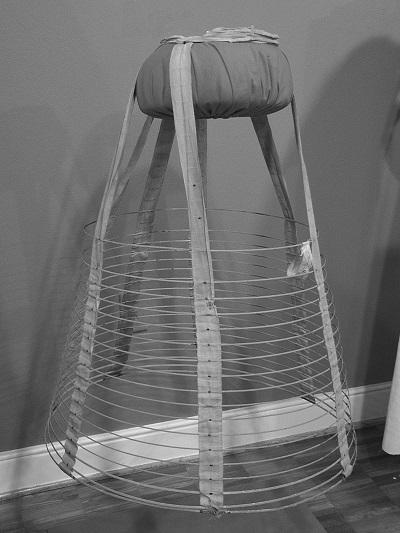
Crinoline, wire underskirt, 1870s
Crinoline, 1870s
Wire underskirts first appeared in the late 1850s, and over time their shape was adjusted to echo the prevailing fashion trend. The shape of this crinoline reflects the style popular in the 1870s. Crinolines provided a foundation for dresses, giving shape to the garments and freeing a woman’s legs from a tangle of petticoats and complex skirts.
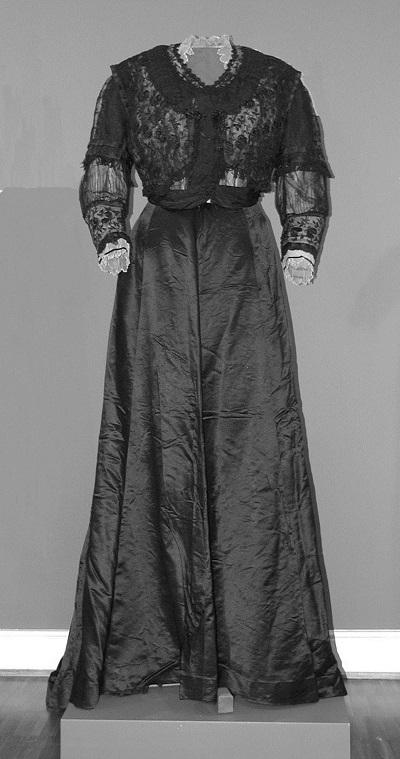
Bodice and skirt, ca., 1905
Bodice and Skirt, ca. 1905
John Douglas Brown’s granddaughter Mary Goulding Hooff Fawcett was widowed in 1901 and like many women of her age and era, chose to wear black for the rest of her life. This bodice has complex layering and detail, including a boned foundation of cream silk taffeta and crepe, covered by layers of black silk net, lace, satin and crepe.
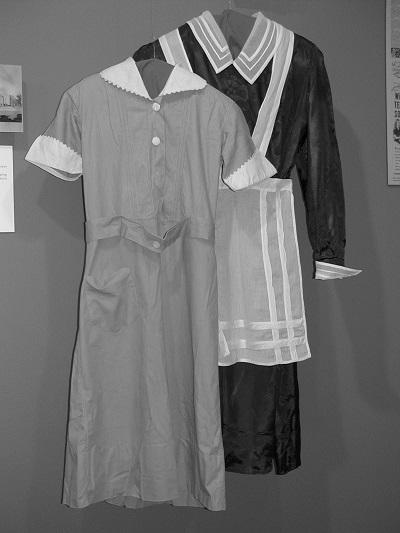
Maids uniforms, 1850s. Grey cotton for daily use and black dress uniform
Maid’s Uniforms, 1950’s
The Fawcett family, great grandchildren of John Douglass Brown, employed an African American house servant, Martha Blue. Martha worked in the house for 39 years, and these uniforms were saved from her years of service. The gray cotton uniform was for daily use. The shiny black uniform, possibly made of rayon, with its white cotton apron and lace collar is characteristic of dressier uniforms --- typically worn for evening events or special occasions in the household.
  • Historic Alexandria
  • Historic Sites
  • Museum Collection
Contact Us
Alex311 | 703.746.4311
Follow Us
  • BlueSky
  • Facebook
  • X
  • YouTube
Visitor Information

VisitAlexandriaVA.com

  • Jobs
  • Payments
  • Departments
  • Newsroom
  • Social Media
  • Emergency Hotlines
  • Accessibility
  • FOIA Requests
  • Privacy & Legal

Alexandria City Hall
301 King Street
Alexandria, VA 22314

City of Alexandria Seal
© 1995–2023 City of Alexandria, VA and others.
Hold on, redirecting...