
Sexual Assault Awareness and Prevention Month (SAAPM 2026)

Embrace Your Voice
Share your original work at the Annual Sexual Assault Awareness Month Poetry Share on Wednesday, April 29.
We are seeking individuals with words that uplift survivors, enlighten our community, and bridge the disconnected.
To participate, register here or see flyer for details

Candlelight Yoga
The DCHS Sexual Assault Center invites the community to a restorative Candlelight Yoga session on Friday, April 24. This event offers a gentle and mindful flow led by Reeya Gandhi, RYT-200, providing a space for peace and reflection.
To participate, register here or see flyer for details.
Teal Out Day
Join the City of Alexandria’s Department of Community & Human Services (DCHS) for Teal-Out Day on Tuesday, April 7. This date marks the Sexual Assault Awareness Month (SAAM) Day of Action, a time to focus on awareness and prevention.
About the Alexandria Sexual Assault Center and How to Donate
The program offers support to victims of sexual assault and their families and friends. Trained volunteers and staff are available 24 hours a day at 703.683.7273 to provide:
- crisis intervention and emotional support
- advocacy with medical, police, and court systems
- short-term individual and group counseling
- information and referrals
In addition to services for individuals, the staff is also available to provide trainings, information, and presentations to local schools and organizations.
The Sexual Assault Center offers information and support for:
- sexual assault (i.e. rape, attempted rape, fondling, indecent exposure, etc.) survivors and their family and friends
- sexual harassment and stalking victims
- women and men of any age, race, ethnicity, immigration status, sexual orientation, gender identity, physical ability, etc.
Many services are offered in both English and Spanish. Staff and volunteers use a confidential translation service to support survivors who speak other languages. View or download Sexual Assault Center and Domestic Violence Program Client Rights and Responsibilities.
Donations
Donate to the Sexual Assault Center. Donations will assist efforts to empower and support families affected by sexual assault.
About Sexual Assault
Sexual assault is an act of sexual violence and aggression which occurs when a person forces, threatens, or coerces an individual into sexual contact without his/her consent. Sexual assault is committed primarily out of anger and/or a need to feel powerful by controlling, dominating, or humiliating the survivor. Examples of sexual assault include rape, sodomy, fondling, indecent exposure, peeping Toms, obscene phone calls, childhood sexual abuse, and sexual harassment.
- People of any age can be victims of a sexual assault.
- Sexual assault happens to women, men and children.
- People of any sexual orientation or gender identity can be victims of sexual assault. LGBTQ people are often targeted for sexual assault and experience an increased risk for sexual violence victimization.
- Approximately 80% of all sexual assaults are committed by someone the victim knows, such as a friend, spouse, family member, date, coworker, or neighbor.
- One in four females, and one in six males, will be sexually assaulted before age 18.
Survivors of sexual assault may experience a variety of after-effects in unique and individual ways. A survivor may feel:
- Loss of control of her/his life
- Anger
- Fear
- Distrust
- Anxiety
- Depression
- Guilt and self-blame - feeling responsible for the assault
- Some survivors find it hard to concentrate, have difficulty sleeping, and may experience mood swings and changed eating patterns.
Easy-to-Share Resources
- Sexual Assault Center Information Card | Spanish | Arabic | Amharic
- 20 Empowering Young Adult Novels
- Staying Safe at Home | Spanish | Arabic | Amharic
- Assistance from a Distance: How to Access DCHS Services During the COVID-19 Pandemic | Spanish | Arabic | Amharic
- Raise Your Voice to Help Neighbors at Risk of Abuse and how to recognize signs of abuse in children and adults | Spanish | Arabic | Amharic
Sexual Assault Response Team (SART) A Coordinated Community Response
Mission
Ensuring that victims of sexual assault receive a coordinated, effective, and compassionate response while working together to prevent sexual assault in our community.
Meet the Sexual Assault Response Team
Principals:
- We are victim-centered: we make sure that everyone is trained to work properly with victims, that our services are coordinated, and that their healing is paramount and separate from the criminal justice process.
- We are accountable: we make sure that everyone is held accountable for providing high quality services to victims based on current standards and that issues are identified and solved in a constructive manner.
- We are proactive: we work together with the community to prevent sexual assault and to educate our fellow community members. We take care of each other to prevent burnout and to support each other to do our best work.
- We are always improving; we look for new practices and other proven ways to prevent sexual assault and to better serve those who are victims.
Participating Agencies (not inclusive):
- Alexandria Police Department
- Alexandria City Public Schools (ACPS)
- Alexandria INOVA Hospital
- Center for Alexandria’s Children
- Commonwealth Attorney’s Office
- Court Services Unit
- Department of Community & Human Services
- Health Department
- Inova Ewing Forensic Assessment and Consultation Teams (FACT) Department
- Legal Services of Northern Virginia
- Office of Housing
- Office of the Magistrate
- Office of Probation and Parole
- Office of Sheriff
- Private Citizens
- Social Services
- Stop Child Abuse Now (SCAN)
- Substance Abuse Services
- Victim Witness Assistance Program (VWAP)
Your participation is needed! If you would like to attend our quarterly SART meeting or have a suggestion to improve the coordinating council and Alexandria's response to sexual assault, please contact 703.683.7273 for meeting times and information.
How You Can Help Support Survivors
Have a friend or loved one who is a survivor of sexual assault or domestic violence? Read guidance on how you can support them:
Take a quiz:
-
Do You Know the Basics of Consent? An online quiz putting your consent skills to the test.
- Donate to the Domestic and Sexual Violence Programs or donate items for the shelter.
- Educate yourself and others. Read and share the resources on this page. Learn more about sexual assault and domestic violence and ways you can help:
-
Information on COVID-19 for Survivors, Communities and DV/SA Programs
If You Have Just Been Sexually Assaulted
- Get to a safe place. If you are in danger or want to report the incident, call for immediate police assistance at 911.
- Contact someone to help you— a friend, the police, the Sexual Assault Center. A Sexual Assault Center advocate is available to talk with you about safety and any other concerns. They will also accompany you to the hospital and police station, if you choose to report the assault. To speak with an advocate contact the Alexandria Sexual Assault Hotline at 703.683.7273.
- Get medical attention right away. You have the right to choose whether or not to report this to the Alexandria Police Department. Regardless of that decision, you can have a Sexual Assault Nurse Examiner (SANE nurse) collect evidence through the use of a Physical Evidence Recovery Kit (PERK). The evidence collection will be done along with a medical exam that will address your medical needs. A medical exam is very important for your health. Keep in mind that you may have injuries of which you are unaware. Medical personnel can talk with you about your options for the prevention of pregnancy or sexually transmitted diseases.
- If possible, do not shower, drink or eat, douche or change your clothes. These activities destroy physical evidence that can be used if you choose to report the assault to the police. It is also important to avoid moving or changing anything at the scene, if appropriate. If you choose to press charges, the police will need to examine the scene for evidence. A Sexual Assault Center advocate is available to accompany you at the hospital 24/7; all it takes is a call to the hotline at 703.683.7273.
Following a Sexual Assault
Emotional reactions:
- Long after the assailant leaves, the effects of the assault may still be with you. The crime has medical, legal and emotional aftereffects which may take weeks, months or years to resolve. During the months following an assault, survivors may continue to experience a wide range of emotions such as fear, distrust, anger, shame, humiliation, and guilt. Some may also believe that there is something wrong with them because they are continuing to have difficulties long after the assault. Remember that there is no typical "time line" for survivors to heal.
- The reality is that everyone recovers at a pace and in a manner that is unique and appropriate to them. Recovery from sexual assault occurs in stages and is very subjective; what one person considers recovered another might not. After several months you may find that acute symptoms, such as nightmares or flashbacks, have lessened or disappeared, while other symptoms, such as higher levels of anxiety and fear, may persist for some time. Survivors may find that certain times and/or events - particularly the anniversary day of the assault - trigger some of these feelings. While it may be frustrating to be experiencing these symptoms of trauma long after the assault, gradually they will decrease in frequency and change in character.
- The ways that survivors handle feelings and reactions will vary. Some try to block intense emotions by becoming very busy while others deal with these feelings by talking about the assault frequently. Some are afraid of crowded situations and prefer to keep to themselves, while others are afraid to be alone. It is important to not become isolated, but the manner and pace in which you deal with these feelings and reactions should be one that is comfortable for you.
Getting Support
- Talking about the assault and developing a network of support can be a very important part of the healing process. For some people, talking with friends and family is most helpful. Some people may prefer speaking with a trained counselor. A counselor can also help you to build a support network and consider the ways in which the people in your life can be helpful. Some people think that asking for help is a sign of weakness. Others see it as making use of available resources and expertise, recognizing that most people are not naturally prepared to handle a sexual assault.
- Many have found support and understanding in talking with other survivors through a support group. Group members discover that they are not alone - that others have felt the same way they do. It is also a chance to share ideas of what has been helpful for recovery. In addition, some have found it helpful to take a self-defense class and/or learn about risk reduction and ways to increase their sense of safety.
Remember...
- Recovery takes time
- It was not your fault
- Being vulnerable or intoxicated is not an excuse for someone to assault you
- Rape or sexual assault is not an act of sex or lust - it is about aggression, power, humiliation
- Complying and cooperation is not the same as consent
- Sometimes cooperating or complying is the safest thing to do
- Take care of yourself physically and emotionally. This includes proper eating, rest and relaxation, doing nice things for yourself, and asking for help.
Virtual Dating App Safety and Education Presentation
Do you know how to stay safe using dating apps? Watch this free presentation on dating app safety and view or download a list of tips on how to safely use dating apps.
Sexual Harassment
- Sexual harassment is unwanted and unwelcome sexual behavior. Sexual harassment may result from words or conduct of a sexual nature that offend, stigmatize, demean, frighten, or threaten you because of your sex.
- Sexual harassment is defined by the person being targeted. The target of sexual harassment and the perpetrator (the one doing the harassing) do not have to agree about what is happening.
- Sexual harassment can happen once or many times. Being the target of sexual harassment may make it scary to go to work/school or hard to concentrate. Incidents of sexual harassment may cause the target to feel uncomfortable, embarrassed, or threatened.
- Employers and school district officials are legally responsible to guarantee a safe environment which is free from sexual harassment and sex discrimination.
- Some forms of sexual harassment are also crimes and should be reported to the police so that the perpetrator(s) can be prosecuted.
What Can I Do?
Tips If You Feel You Are the Target of Sexual Harassment
- Let the harasser know you don't like the behavior or comments. If you feel safe and comfortable doing so, tell the harasser that his or her behavior bothers you and that you want it to stop.
- Tell someone and keep telling until you find someone who believes you. Find supporters and talk with them about what's happening. The point is to find someone you can trust.
- Do not blame yourself for sexual harassment. Harassment is unwanted and can make you feel trapped, confused, helpless, frustrated, embarrassed, and scared. You certainly did not ask for any of those feelings.
- Keep a written record of the incidents: what happened, when, where, who else was present, and how you reacted. Save any notes or pictures you receive from the harasser.
- Go to a supervisor or school staff member. If you feel uncomfortable, it is okay to bring a coworker, friend or parent with you to that meeting.
For Friends and Loved Ones
A friend or a loved one who has been sexually assaulted may confide in you right after the assault or many years later. As someone close to a survivor, you can offer invaluable assistance and can make a significant difference in her/his recovery.
Ways to Help
- Listen...then listen some more. Let them know you are available whenever they are ready - which may be weeks, months, or years later.
- Let them express their feelings. Focus on listening instead of offering advice or asking questions.
- Don't minimize feelings or concerns or pretend that the assault wasn't serious.
- Believe her/him. This includes believing that their actions during the assault were correct.
- Let them make their own choices. You may help think about options, but let them make the decision.
- Reassure him/her it was not their fault.
- Be available, yet be realistic. Let them know how much support you can give. You will be more helpful if you are realistic in your commitments.
- Respect their pace in healing, including sexual intimacy. Let them take the initiative.
- Learn about sexual assault.
- Respect her/his privacy. The survivor should be the one to decide who should know about the sexual assault and how they should be told. Do not tell anyone without the survivor's permission.
- Ask how you can help.
Take care of yourself. Be aware that this may be a crisis for you too, and you may experience a variety of emotions. Not addressing your own feelings may make it difficult to offer strength and support to the survivor. The services of the Sexual Assault Center are available to the significant others of an assault survivor. Contact the Sexual Assault Center hotline at: 703.683.7273.
Support Groups
Survivors of sexual assault or childhood sexual abuse sometimes find it helpful to talk about their feelings with others who have had similar experiences. All groups are time limited and address a variety of issues related to sexual violence. Discussion topics may include: guilt, shame, fear, anger, trust, self-esteem and relationships with family and friends. Listed below are groups offered throughout the year by the Sexual Assault Center. The times and dates are subject to change, and this web page will be updated accordingly. Unless otherwise noted, all groups will be held at the Sexual Assault Center at 123 North Pitt Street, Suite 225 in Alexandria. Please call the Sexual Assault Hotline at 703.683.7273 for more information or to register for a group or class.
*Pre-registration is required for all groups and classes
Sexual Assault Center sponsors Virtual Support group for adult sexual assault survivors: This is a six-week group for adult sexual assault survivors. The group will meet virtually 4:30 to 6 p.m. every Tuesday between January 30 and March 5. Group is limited in size. Intake required. Group is non gender specific. For more information contact Gloria Saez at Gloria.Saez@alexandriava.gov or call 703.850.9426.
Adult Survivors of Childhood Sexual Assault: This is an eight-week group for survivors who were sexually assaulted as children. Address the impact that the sexual abuse has had on survivors’ lives and explore methods that survivors may use to help them cope with and heal from the abuse. All group members must be receiving individual therapy or case management services while in the group. All members will meet with a Sexual Assault Center group facilitator before group begins. Please call the Sexual Assault Hotline at 703.683.7273 for more information or to register for upcoming sessions.
Adult Survivors of Sexual Assault: This is an eight-week group for survivors who were sexually assaulted as adults. This group will explore the impact that sexual assault has had on survivors’ lives and will address topics connected to healing from the assault. All members must meet with a Sexual Assault Center group facilitator before group begins. Please call the Sexual Assault Hotline at 703.683.7273 for more information or to register for upcoming sessions.
The Non-offender Caregiver support group: This is a psycho educational group appropriate for caregivers of alleged victims of sexual abuse. The group creates a safe space for caregivers to identify and express their feelings regarding their child’s abuse. Parents should expect an increase of knowledge about sexual abuse and how it affects the victim and their families. Please call the Sexual Assault Hotline at 703.683.7273 for more information or to register for upcoming sessions.
Prevention, Education and Awareness
The Sexual Assault Center is dedicated to building a safer community where no one has to be a victim or perpetrator. Our Prevention and Education Program is designed to build awareness of the prevalence of this issue on a national and local level among Alexandrians in an effort to stop sexual violence before it occurs. In addition, we aim to change negative attitudes, beliefs, and behaviors that lead to sexual violence. The Sexual Assault Center reaches out to schools, youth servicing organizations as well as adult civic associations and military within Alexandria to provide free prevention presentations on an array of topics. These topics include but are not limited to prevention, awareness, healthy relationships, sexual harassment and bystander intervention of sexual violence. Behind education, taking a stand against violent and oppressive behaviors is the first step towards preventing sexual assault. Respecting individuals, encouraging independent thought, and demanding justice are key to building a violence-free society. To schedule a free presentation for your organization please call the Sexual Assault Center at 703.746.3118.
Prevention: Preventing sexual violence starts with building awareness in the community on the issues of sexual harassment and sexual violence and focusing on those committing the act. The goal of prevention programs is to provide the tools and resources to help reduce or diminish risk factors and to strengthen protective factors. Understanding and challenging belief systems that blame the victim and protect the rapist are key in achieving a violence-free community.
Bystander Intervention: Bystander intervention addresses the behaviors of others— the friends, families, teachers, clergy, coaches and witnesses that surround any act or pattern of abuse. This training will discuss the concept of bystander intervention along with shifting the responsibility away from just the victim and perpetrator to provide a space for individuals outside these roles to join the movement. Placing responsibility on the community as a whole will prevent more acts from escalating to the point of sexual violence. In addition, this training offers strategies for being proactive, addressing the behaviors before sexual violence has been perpetrated in the first place, and reactive, addressing the behavior as an intervention response to an act of violence that has already been perpetrated. Educating and creating community awareness on how to prevent sexual violence will create a community culture where people will be more willing to speak up and say or do something when there is an opportunity to act.
Click here to learn more about the Sexual and Domestic Violence Prevention Project.
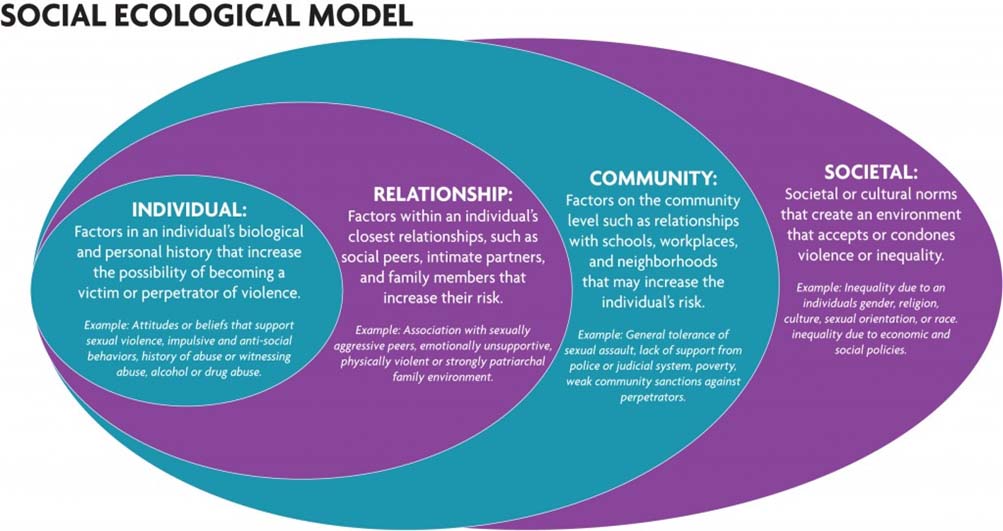
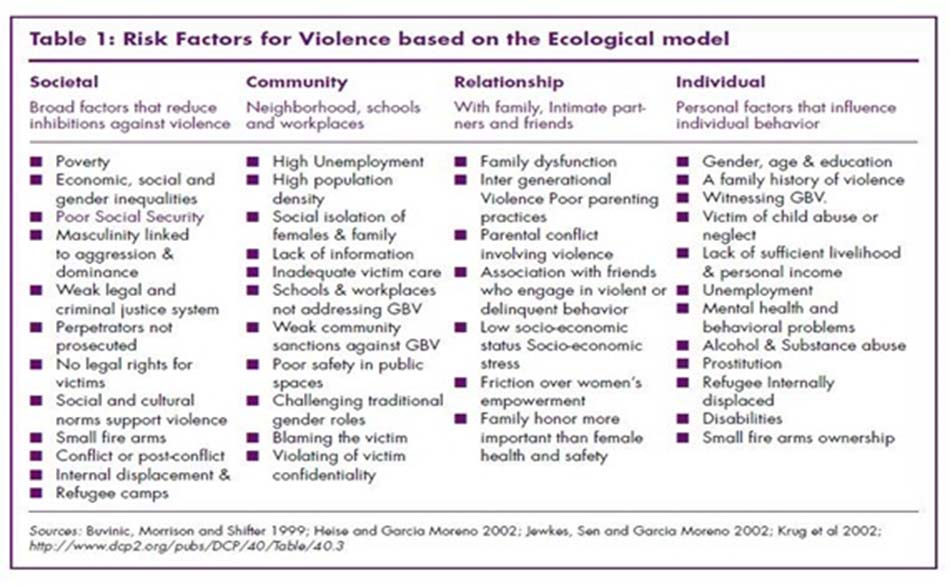
The Alexandria Sexual Assault Center strives to work from the Social Ecological Model. This model considers the complex interplay between individual, relationship, community, and societal factors. It allows us to understand the range of factors that put people at risk for violence or protect them from experiencing or perpetrating violence. While we recognize that risk reduction may be beneficial at times, the focus is on potential victims, which may impose an unjust burden for individuals to carry in preventing perpetration against their person. People often ask what they can do to keep themselves safe. Yet, it is important to remember that whether or not risk reduction and/or safety tips are taken, a victim is NEVER responsible for preventing their assault. Below is a list (Table 1) of potential risk factors that may contribute to the perpetration of gender based violence, including sexual assault. However, this is not meant to be an exhaustive list, but rather a resource to increase your knowledge and understanding of the various influences.
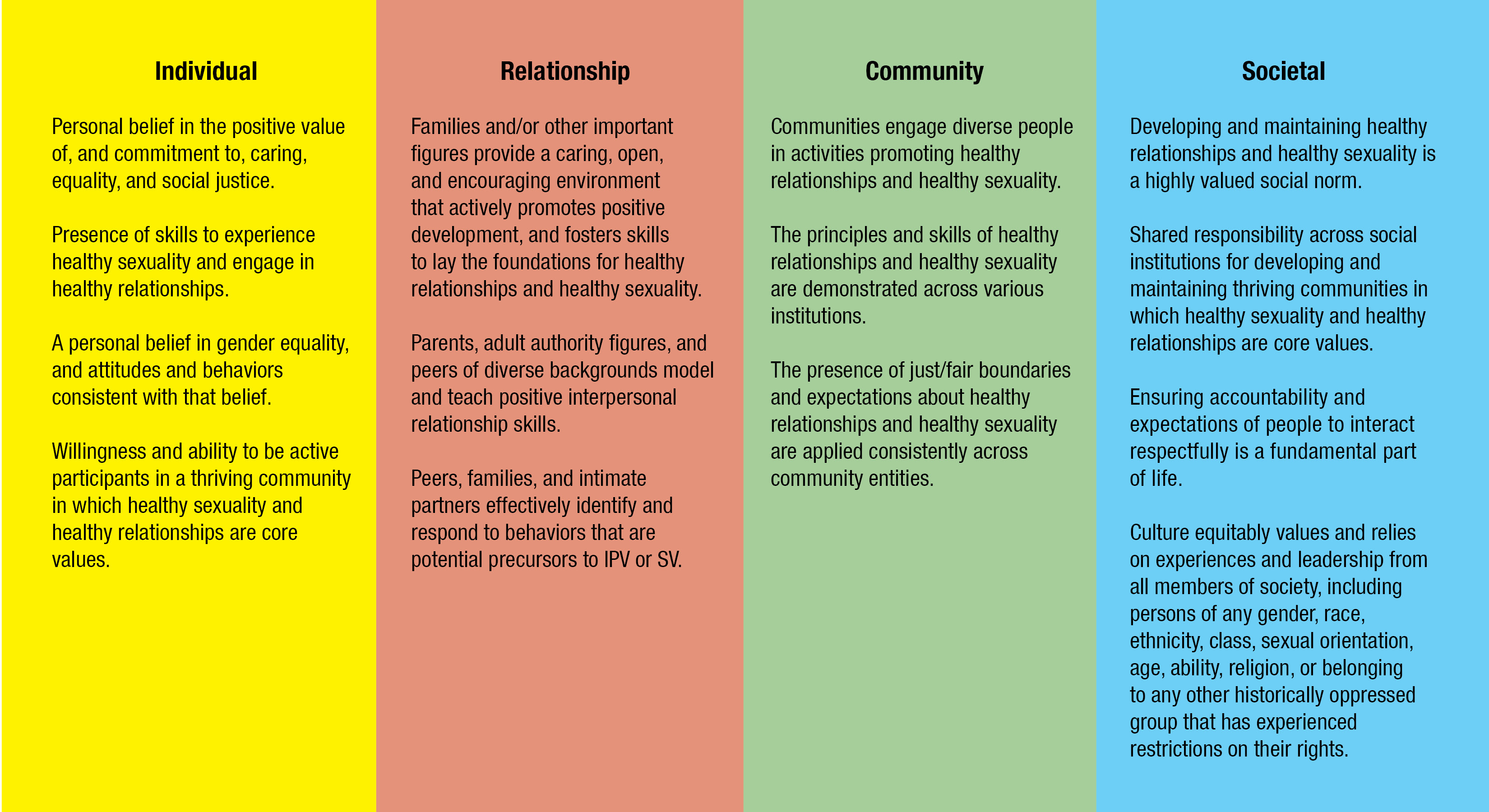
While risk factors help us to understand underlying root causes which support sexual violence, recognizing protective factors is an integral component. The Virginia Sexual and Domestic Violence Action Alliance describes protective factors as the conditions or characteristics that decrease the likelihood of SV/IPV perpetration, while also facilitating a broad range of related positive outcomes. A single protective factor does not necessarily directly prevent SV/IPV, but the presence of multiple protective factors decreases the chance of perpetration. The protective factors illustrated in the chart below are outline factors following the Social Ecological Model:
Domestic Violence and LGBTQ Services
Learn about Domestic Violence services and LGBTQ resources.
Volunteer Opportunities
MAKE A DIFFERENCE!
Alexandria's Sexual Assault Center and Domestic Violence Program need your help! Be a volunteer hotline advocate! Volunteers accompany survivors to the hospital or police station and provide crisis intervention and resources over the phone to survivors of sexual assault and their loved ones and more. Check out the flyer for more information. For sexual assault center inquiries, call 703.746.3122. For domestic violence program inquiries, call 703.746.3647.

Volunteers are an integral part of the Sexual Assault Center. After a comprehensive 40-hour training course, volunteers may become advocates. Volunteers respond to the 24-hour hotline on evenings and weekends. They provide emotional support and information to assist victims in regaining control of their lives. Volunteers also accompany victims of sexual assault to the police department and/or hospital.
Requirements are:
- 21 years or older
- Have reliable transportation to INOVA Fairfax Hospital (not metro accessible)
- 40 hours of training plus 12 hours of shadow shift
- Commit to minimum of two 12-hour shifts per month
- Ability to work with numerous community response teams
- Ability to work calmly and independently at hospital
- Maintain confidentiality
- Background Check required.
If you are interested in more information about volunteering, call 703.746.3127 to speak to the volunteer coordinator. See the volunteer application.
Community Education: Presentations and workshops on sexual assault and related topics are offered to community groups. This includes presentations for youth, adults and Spanish-speaking audiences. Other community education events include Denim Day, and Messages of Hope campaign held each April, which is recognized as Sexual Assault Awareness Month. Presentations are available upon request. To schedule a presentation for your group please call a prevention specialist at the Sexual Assault Center at 703.746.3118.
Resources and Related Links
Alexandria
- Alexandria Domestic Violence Shelter (703.746.4911)
- Alexandria Police Department, Non-Emergency (703.746.4444)
- Alexandria Child Protective Services (703.746.5800, local) (1.800.552.7096, national)
- Alexandria Hospital ER (703.504.3066)
- Alexandria Victim Witness Assistance Program (703.746.4100)
- Alexandria Adult Protective Services (703.746.5778)
Arlington
- Doorways for Women and Families (703.228.4848)
Fairfax
- Office for Women & Domestic and Sexual Violence Services (703.360.7273)
- INOVA Fairfax Hospital Emergency Room (703.776.3116)
Washington DC
- DC Rape Crisis Center (202.333.7273)
Virginia
- Virginia Family Violence and Sexual Assault Hotline (1.800.838.8238)
Additional Reading
- Preventing Sexual Assault on College Campuses
- The Relaxation & Stress Reduction Workbook, Martha Davis, PhD; Elizabeth Robbins Eshelman, MSW; Matthew McKay, Ph.D.
- Healing From Trauma, Jasmin Lee Cori, MS, LPC
- The Body Remembers, The Psychophysiology of Trauma & Trauma Treatment (for professionals), B. Bothschild
- 8 Keys to Safe Trauma Recovery: Take Charge Strategies to Empower Your Healing (for survivors), B. Rothschild
- Coping with Trauma-Related Dissociation: Skills Training for Patients and Therapists, S. Boon, K. Steele, O. Van Der Hart
- Healing from Trauma: A Survivor's Guide to Understanding Your Symptoms and Reclaiming Your Life, J.L. Cori.
- The Body Keeps the Score: Brain, Mind, and Body in the Healing of Trauma by Bessel van der Kolk M.D.
- Superando el dolor/ Overcoming the Pain: Un libro para y acerca de adultos abusados en la ninez, Eliana Gil